The Sun Stone
Aperitif Anyone?
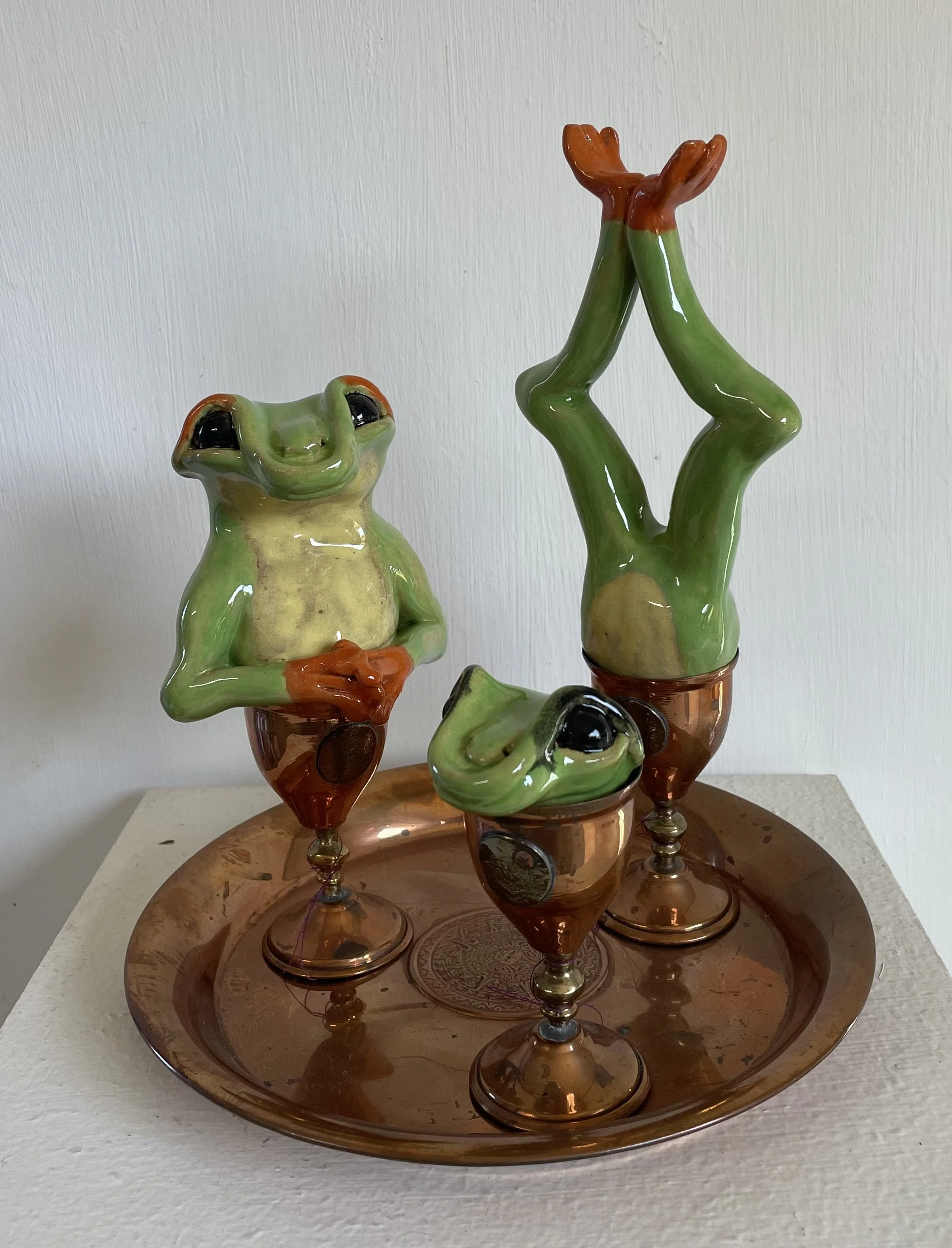
When I found a charming set of six copper aperitif glasses with a matching tray, I immediately envisioned them with frogs coming out and interacting with each other. After making the first couple of frogs though I quickly realized that six cups with frogs would not fit onto the tray after all so I revised my idea to having three ‘aperitifs’ on the tray.
I always enjoy learning more about the little treasures I pick up. This set has a little brass emblem on the front of each glass that refers back to the Mayan or Aztec calendars. The emblem is based on a reproduction of The Sun Stone. It turns out that using the Aztec Sun Stone symbol on these types of pieces is popular because it serves as a ‘powerful emblem of Mexican heritage, Indigenous pride, and cultural identity’.
Researching further I found out that there are 2 calendars in the Mayan and Aztec system. One has 365 days, like our calendar, and is sometimes thought of as an agricultural calendar, and the other one has a 260-day cycle. If I’m understanding things, the Sun Stone symbols go with this second 260-day cycle which has a number and symbol sequence that is pretty interesting.
I’ve always liked number patterns so I’m surprised that I never knew about this one before. Here’s a description of how it works:
The system of the tonalpohualli can be best understood by imagining two wheels that are connected to each other. One wheel has the numbers "one" to "thirteen" written on it. The second wheel has twenty symbols on it. In the initial situation, number "one" combines with the first symbol. This is the first day of the tonalpohualli. Now the wheels start moving and number "two" combines with the second glyph. This is the second day. After fourteen days, an Aztec week (trecena in Spanish) of thirteen days has passed. The wheel with the numbers shows number "one" again. The other wheel now shows the fourteenth symbol. After 260 days, the two wheels have returned to their initial position. The tonalpohualli starts all over again.
“At the heart of Tenochtitlan, the mighty Aztec Sunstone stood as more than just a calendar—it was a cosmic map, a guide to the universe, and, some say, a prophetic artifact. According to legend, it held the power to predict great events, including the fall of the empire and the rise of a new era. During the Spanish conquest, priests, fearing its power would be misused, supposedly hid it beneath the waters of Lake Texcoco, along with other sacred treasures. While a Sunstone was later recovered, many believe the original remains hidden, waiting for the return of the gods at the end of the Fifth Sun, when balance will once again be restored.”
Here’s a link to a more complete description of the calendars and how they work. https://www.azteccalendar.com/azteccalendar.html
It’s funny that traditionally drinking an apéritif is supposed to act as a mental and social pause to transition from the workday into an evening of dining and conversation. And here our little aperitif glasses have led us to a conversation about the Aztec calendar. I guess they are still doing their job!
I do love learning this stuff, it makes the little pieces I collect and combine with my sculptures all the more interesting to me. I like that the pieces all have a previous use and history before I repurposed them. Hopefully these little pieces have ‘whet your appetite’!
Do you have a piece with an interesting story?